Logout
Login


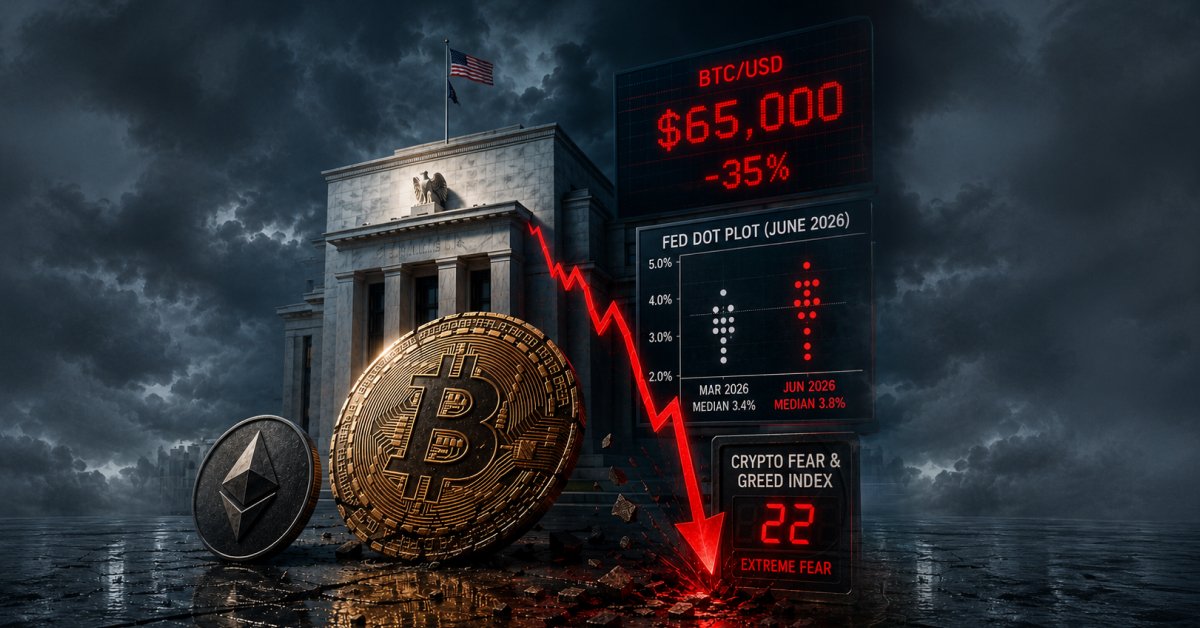
The cryptocurrency market entered June 2026 already bruised. After Bitcoin climbed to extraordinary highs above $126,000 in early 2025 and spent much of Q1 2026 consolidating around the $80,000–$90,000 range, the second quarter delivered a sharp and unforgiving correction. By the time Chair Kevin Warsh stepped up to his first Federal Open Market Committee press conference on June 17th, Bitcoin was trading near $65,000 — roughly 35% below its all-time high and at a level that was raising serious questions among both retail investors and institutional desks alike.
What Warsh announced was not what the market had priced in. And the consequences for digital assets in the months ahead are significant.
The June 17 FOMC meeting was, on the surface, uneventful. The Federal Reserve held its benchmark interest rate steady at 3.50%–3.75%, exactly as the 97% probability implied by futures markets suggested. No surprise there.
The surprise was in the updated Summary of Economic Projections — the so-called "dot plot" — that accompanied the decision. In March, the committee's median projection had pointed to one 25-basis-point cut before the end of 2026. That cut is now gone. The June dot plot shows a median year-end rate projection of 3.8%, up from 3.4% in the previous edition. More striking still: nine of the eighteen committee members now expect at least one rate increase before December.
The Fed, in effect, went from signaling a cut to signaling a hike — in a single meeting.
The catalyst is inflation. The committee revised its 2026 PCE inflation forecast to 3.6%, a dramatic jump from the 2.7% projection issued just three months ago. Geopolitical tensions, particularly the ongoing Iran conflict and its effect on energy prices, are cited as key drivers. Combined with a May CPI print of 4.2% — nearly double the Fed's 2% target — the message from Washington is unmistakable: the era of monetary accommodation is not returning anytime soon.
One of the most important lessons from the 2025 cycle was that crypto markets do not move on rate decisions. They move on expectations. The June 17 dot plot revision is not a rate hike. It is a recalibration of the entire forward trajectory — and that recalibration reprices risk assets across the board.
Consider the sequence of events that brought us here. Spot Bitcoin ETFs, which drove enormous institutional inflows through 2024 and 2025, closed May 2026 with $2.30 billion in net outflows — the largest monthly redemption of the year and the steepest since November 2025. This came even as Bitcoin itself only fell 3.69% in May, a telling divergence: institutions were derisking far faster than the price action suggested. The "smart money" had already started moving to the exits before Warsh took the podium.
Bitcoin and Ethereum, as we have written before, are deeply sensitive to the global liquidity cycle. When the Fed signals that money is staying expensive and that the window for "cheap capital" has closed indefinitely, the assets that benefited most from the prior era of loose monetary policy face mechanical, structural headwinds — not because their technology has failed, but because the financial plumbing that feeds speculative capital has been tightened.
The Fed's hawkish pivot does not exist in isolation. At Geco Capital, we view the current environment as the convergence of at least three distinct headwinds operating simultaneously.
First, the BOJ unwind is still in progress. As we detailed in our April analysis, the Bank of Japan's march toward a 1% benchmark rate has been unwinding the Yen carry trade — a decades-long mechanism by which global investors borrowed cheaply in yen to fund positions in risk assets worldwide. That process does not happen overnight. Capital is still flowing back toward Japan, and the pressure on dollar-denominated risk assets has not yet fully resolved.
Second, new Fed leadership has introduced genuine uncertainty. Chair Warsh is making his policy intentions known through action, not just language. His first meeting produced an immediate hawkish signal. Unlike the more predictable communication frameworks of the Powell era, the market is still learning what Warsh's reaction function looks like — and uncertainty, in markets, is never bullish for volatile assets.
Third, the regulatory clarity that arrived in March has yet to translate into buying pressure. The SEC's March 17 interpretive release classifying Bitcoin, Ethereum, Solana, and XRP as digital commodities rather than securities was a genuinely historic development — one that materially reduces legal risk for institutional holders of these assets. Yet institutional demand has not surged in response. The reason is straightforward: regulatory clarity is a necessary condition for institutional capital, but it is not a sufficient one. When rates are high and liquidity is scarce, even legally "clean" assets struggle to attract fresh inflows.
The Crypto Fear and Greed Index sat at 22 entering the FOMC week — firmly in "extreme fear" territory. For students of market history, this number carries meaning beyond sentiment.
Periods of extreme fear in crypto have historically coincided with the most attractive accumulation windows of any given cycle. This is not a comfortable observation to act on in real time — capitulation rarely feels like opportunity while it is happening — but the data is consistent. The question for disciplined investors is not whether this correction represents an opportunity, but when the macro environment will allow that opportunity to be realised.
At the current juncture, with the next PCE inflation reading due June 25 and a major Deribit quarterly options expiry following the day after, the near-term volatility window remains wide open. A higher-than-expected PCE print would further entrench the "higher for longer" narrative. A softer reading could begin to restore some confidence that the June dot plot revision was more cautious than the underlying data will ultimately require.
Either way, the summer will be defined by this data, not by blockchain fundamentals.
Within the Geco Capital Large Cap Fund, our team has maintained the defensive and opportunistic posture we outlined in April. Elevated stablecoin reserves, strict focus on the top-tier digital assets with the deepest liquidity profiles, and staged accumulation protocols that activate at key technical levels — these are the tools that allow active managers to navigate cycles like the current one without suffering the full drawdown that undisciplined, passive holders experience.
We want to be direct with our investors: the bottom of this cycle has not yet been confirmed. Analyst Benjamin Cowen's long-held view — that the 2026 cycle bottom may come as late as October — remains a credible framework. The convergence of Fed hawkishness, ETF outflows, BOJ normalisation, and geopolitical uncertainty is not the kind of environment that resolves quickly.
However, the structural story for digital assets has not changed. Bitcoin's fixed supply, its growing institutional legitimacy, and the irreversible shift in regulatory posture from the SEC all point toward a foundation that is meaningfully stronger than in any previous cycle. The assets we hold within DLCF are not facing existential risk. They are facing a liquidity drought, and liquidity droughts, by definition, end.
For investors trying to navigate the second half of 2026, we offer the following framework:
The near-term trajectory will be governed by three sequential events. The May PCE print on June 25 will either confirm or challenge the Fed's revised inflation outlook. The Deribit quarterly expiry on June 26 will clear significant options positioning and potentially reduce near-term volatility. And the September FOMC meeting will deliver the next Summary of Economic Projections, which will tell us whether the June dot plot was a one-off warning or the beginning of a sustained tightening trajectory.
If PCE softens and Warsh's September dots retreat toward the March baseline, the "buy the dip" thesis gains credibility and the rally into year-end could be sharper than most currently expect — Standard Chartered, for instance, still has a $100,000 year-end target despite the recent caution. Bernstein remains at $150,000.
If PCE surprises to the upside and September brings another hawkish revision, the October low scenario becomes the central case, and accumulation strategies should be scaled accordingly.
In both scenarios, the disciplined investor with dry powder is better positioned than the investor who either sold in panic or bought prematurely. The Warsh pivot has reset the game board. The pieces are still the same. The timing has shifted.
June 2026 is not a moment for euphoria, and it is not a moment for despair. It is a moment that rewards patience and macro literacy — the same qualities that have defined Geco Capital's approach since inception.
The Fed has told us, clearly, that cheap money is not coming back in 2026. The BOJ is telling global investors the same thing from the other direction. And yet, beneath this macro noise, the technology continues to develop, adoption continues to expand, and the regulatory framework continues to mature. The next major crypto bull cycle will not be built on the same liquidity conditions that fuelled the last one. It will be built on genuine institutional adoption, a clearer legal landscape, and the accumulated demand of a world that increasingly understands what Bitcoin and digital assets actually are.
That cycle is coming. It is simply not here yet.
For our investors: stay patient, stay informed, and trust the process. The best opportunities in any asset class are forged in periods exactly like this one.


