Logout
Login


The global financial landscape is currently standing at a precipice,facing a seismic shift that has not been witnessed in over threedecades. For the first time in thirty-one years, the Bank of Japan (BOJ) is positioned to raise its benchmark interest rate to 1.00%.While a single percentage point might seem modest in the context ofthe aggressive hiking cycles seen in the United States or Europe overthe past few years, the implications for global liquidity—and byextension, the cryptocurrency market—are nothing short ofmonumental.
This is not merely a story about Japanese monetary policy; it is theunfolding of a global liquidity narrative. For decades, the "YenCarry Trade" has served as the silent engine behind theappreciation of risk assets worldwide. By borrowing in a currencywith near-zero interest rates and investing in higher-yielding assetsabroad, investors have pumped trillions of dollars into everythingfrom U.S. Treasuries to high-growth tech stocks and, most recently,digital assets. As the BOJ prepares to pull the plug on this era offree money, the ripples are already being felt across the digitalfrontier.
At Geco Capital, particularly within our Geco Capital Large Cap Fund, we have been closelymonitoring these macroeconomic indicators. Our investment philosophyhas always been rooted in the understanding that while blockchaintechnology is revolutionary, the price of digital assets isultimately a function of global liquidity. As we stand in April 2026,with the June rate hike priced at a staggering 90% probability, webelieve the market is entering a critical phase of deleveraging thatwill provide the ultimate "buy the dip" opportunity fordisciplined investors.
The End of the Free MoneyEra
To understand the gravity of the current situation, one must lookback at the historical trajectory of Japanese yields. Since 2019, theJapan 10-year government bond yield has surged by over 1000%, climbing from negative territory to levels that are now attractingsignificant domestic and international capital. This shift representsmore than just a change in numbers; it is a fundamental reversal ofthe capital flows that have defined the 21st-century financialsystem.
When the Bank of Japan raises rates, it effectively increases thecost of the world’s most popular funding currency. As the yenstrengthens and domestic yields become attractive, the trillions ofdollars parked in foreign risk assets begin to "return home. "This process, known as the unwinding of the carry trade, acts as amassive vacuum, sucking liquidity out of global markets.
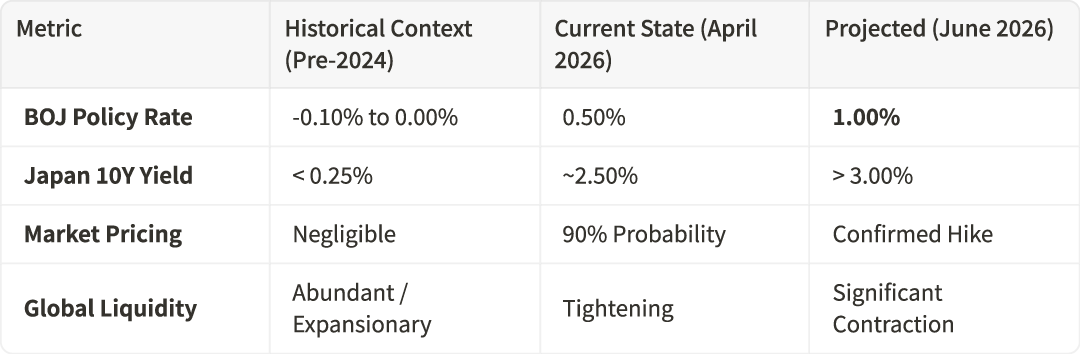
The table above illustrates the dramatic shift in the Japanesemonetary environment. The move to 1.00% is a psychological andstructural threshold that the market has not had to navigate in ageneration. For a market like crypto, which thrives on excessliquidity and "cheap" capital, this transition is theultimate stress test.
It is a well-established fact in modern finance that cryptocurrencyis often the first asset class to feel the effects of liquidityshifts. Because digital assets are traded 24/7 and are highlysensitive to changes in the global M2 money supply, they act as a"canary in the coal mine" for broader market corrections.
Historical data regarding previous Bank of Japan rate hikes providesa sobering preview of what may lie ahead. In every instance over thepast few years where the BOJ has moved toward normalization, Bitcoinand the broader digital asset market have experienced significantdrawdowns.
"Historical patterns suggest that everymajor BOJ policy shift in the current cycle has been accompanied by aBitcoin correction of at least 20%. In March 2024, the market saw a23% dip; in July 2024, a 26% decline; and as recently as January2026, a 31% retracement occurred following hawkish commentary fromTokyo."
These are not coincidences. They are the direct result of institutional deleveraging. When a hedge fund facing rising borrowing costs in yen needs to raise cash quickly to cover margins orrebalance portfolios, the most liquid and easily exitedpositions—often Bitcoin and Ethereum—are the first to be sold.
Many retail investors make the mistake of viewing crypto in a vacuum, focusing solely on network upgrades, ETF inflows, or regulatory news. While these factors are important for long-term adoption, they areoften overshadowed in the short term by the "Global LiquidityStory."
The current situation in Japan is the final piece of a global tightening puzzle. With the U.S. Federal Reserve maintaining a"higher for longer" stance and the European Central Bank grappling with its own inflationary pressures, the disappearance ofthe Japanese liquidity cushion removes the last safety net forrisk-on portfolios.
The unwinding of carry trades is a non-linear process. It often starts slowly and then accelerates as stop-losses are triggered andvolatility spikes. We are currently in the "anticipatory" phase, where the smart money is moving to the sidelines, increasingcash positions, and preparing for the volatility that the June rate hike will inevitably bring.
At Geco Capital, our approach to the Geco Capital Large Cap Fund is defined by active management and strategic patience. We do not believe in blindly holding through every market cycle regardless of the macroeconomic environment. Instead, we utilize a data-driven framework to identify periods of extreme risk and extreme opportunity.
As the market prices in the 90% probability of a BOJ hike to 1.00%, our team has shifted toward a defensive yet opportunistic posture. We are currently maintaining higher-than-average stablecoin reserves within the fund, specifically waiting for the liquidity-driven "washout" that historical data suggests is coming.
For the long-term investor, a 20-30% correction driven by liquidity rather than fundamental failure is a gift. The underlying technology of the Top 100 digital assets we track remains robust. Institutional adoption continues to grow, and the utility of decentralized finance and smart contract platforms is expanding daily.
A price drop triggered by the Bank of Japan is a "mechanical" correction. It is caused by forced selling and deleveraging, not by a change in the intrinsic value of the assets themselves. This createsa classic "valuation gap" that active managers like Geco Capital are designed to exploit.
Our strategy for the coming months involves:
The transition to a 1.00% interest rate in Japan marks the end of an era. For three decades, the world has operated under the assumption that Japanese capital would always be cheap and always be available. That assumption is now dead.
In this new paradigm, volatility will be higher, and the "easymoney" gains of the past may be harder to come by. However, forthose who understand the macro-drivers of the market, this environment offers unparalleled opportunities for alpha generation. The 1000% increase in Japan's 10Y yields since 2019 was the warningshot; the June 2026 rate hike is the main event.
Investors must ask themselves: Are you positioned for a world where the Yen is no longer a free source of leverage? Or are you holding onto a strategy that was built for a market that no longer exists?
The coming months will likely be some of the most volatile in the history of the digital asset market. The convergence of a historic BOJ rate hike, the unwinding of trillions in carry trades, and thesensitive nature of crypto liquidity creates a "perfect storm" for a significant market correction.
However, at Geco Capital, we view this storm not with fear, but with anticipation. Market corrections are the mechanism by which wealth is transferred from the impatient to the disciplined. By staying grounded in macroeconomic reality and maintaining the flexibility to "shop at the dip," we aim to position Geco Capital Large Cap Fund to capture the next leg of the digital revolutionat significantly more attractive valuations.
The 90% probability of a June hike is a signal to prepare, not to panic. The global liquidity story is shifting, and for the prepared investor, the best opportunities are yet to come.


