Logout
Login


The first week of April 2026 will be etched into financial history as a defining moment of intense geopolitical volatility, where social media rhetoric and diplomatic breakthroughs collided to reshape global markets in less than 48 hours. At the center of this storm were two primary forces: the escalating tensions between the United States and Iran, and the unfiltered communication of President Donald Trump. For investors in digital assets and commodities, the events of April 7th and 8th provided a masterclass in market psychology, risk management, and, ultimately, the undeniable resilience of Bitcoin.
As the world watched the Strait of Hormuz—the world’s most critical maritime chokepoint—the "doom and gloom" narrative initially threatened to send global markets into a tailspin. Yet, as the dust settles on a historic two-week ceasefire agreement, the data reveals a surprising outcome. While oil prices experienced a dramatic correction, Bitcoin did more than just survive; it staged a recovery that reinforces its growing status as a cornerstone of the modern institutional portfolio. This article explores the mechanics of this "perfect storm," the rhetoric that triggered it, and why the recovery of BTC marks a pivotal moment for digital finance.
To understand the magnitude of the "doom and gloom" post, one must first revisit the four weeks leading up to April 7, 2026. The Middle East had been gripped by a series of escalating confrontations that many analysts feared were the opening salvos of a broader regional conflict. For over forty days, targeted strikes and maritime incidents had become almost daily occurrences. The global energy market, always sensitive to instability in the Persian Gulf, had responded by pricing in a significant "war premium." By early April, Brent Crude had surged past $110 per barrel, its highest level in several years. This spike in energy costs was beginning to ripple through the global economy, raising fears of "stagflation"—a toxic combination of stagnant economic growth and high inflation. Central banks, which had only recently begun to find a stable path for interest rates, were once again forced onto the defensive. It was in this high-stakes environment that the digital asset market, led by Bitcoin, faced its most significant geopolitical test of the year.
The "war premium" was not just a theoretical concept; it was a physical reality for businesses and consumers. Logistics companies faced soaring fuel surcharges, and airline stocks plummeted as the cost of jet fuel reached levels not seen in over a decade. The threat of a closed Strait of Hormuz was the "black swan" that every analyst was watching. When the news cycle is dominated by images of tankers being diverted and military drills, the market's natural reaction is to seek safety. But in 2026, the definition of "safety" is undergoing a profound transformation.
On the afternoon of April 7, 2026, President Donald Trump took to his social media platforms to issue a warning that would immediately halt the ongoing market rally. The post, which quickly became known as the "doom and gloom" message, warned of catastrophic economic consequences if the "Iran nuclear threat" was not resolved immediately.
Trump’s rhetoric was dual-faceted: he acknowledged the pain of soaring energy costs but framed them as a "small price to pay" for the ultimate "destruction" of the Iranian threat. The immediate reaction in the trading pits was one of "risk-off" sentiment. Equity futures dipped, and the "doom and gloom" phrase began to trend, reflecting a collective anxiety that the geopolitical situation was about to deteriorate further before it could improve.
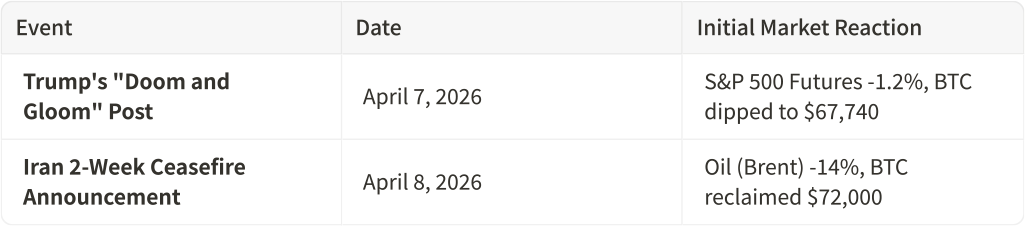
For digital asset investors, this was a moment of truth. Historically, Bitcoin has been viewed both as a "risk-on" asset and as "digital gold." In the hours following the post, the "risk-on" correlation initially dominated, with BTC falling from its daily highs near $72,000 to a sharp low of $67,740. This 6% intraday dip was a direct reflection of the uncertainty surrounding Trump’s next moves. However, as we have seen time and again, the initial panic often masks a deeper, more resilient underlying trend.
The "doom and gloom" post was not just a message; it was a psychological weapon. In the age of algorithmic trading, keywords like "doom," "gloom," and "destruction" trigger immediate sell orders. This phenomenon, akin to a "flash crash," was absorbed with remarkable speed. Within minutes of the initial sell-off, large-scale buy orders began to appear on major exchanges, indicating an institutional "bid" that has become a backbone of the Bitcoin market.
The psychology of a "war premium" is a complex interplay of physical supply fears and speculative hedging. When a major producer or a critical transit route is threatened, traders don't just react to current supply levels; they react to the possibility of a total cutoff. In the case of the Strait of Hormuz, through which approximately 20% of the world's oil consumption passes, the stakes couldn't be higher.
Trump's rhetoric tapped directly into this fear, signaling to the markets that the U.S. was prepared for prolonged disruption if it meant achieving its strategic goals. This marked the peak of the "war premium," with the market briefly pricing in a worst-case scenario of a closed Hormuz, regional war, and $150 oil.
However, the digital asset market showed signs of divergence. While traditional equities remained suppressed, Bitcoin's dip to $67,740 was met with significant buying pressure. This "buying the dip" behavior, even amidst "doom and gloom," suggested that a new class of institutional and long-term investors was beginning to see Bitcoin as a hedge against the very instability Trump described.
The "war premium" in oil is essentially a tax on uncertainty. For Bitcoin, however, uncertainty often acts as a catalyst. This fundamental paradox highlights that while physical commodities are constrained by real-world logistics, Bitcoin is a pure play on global liquidity and trust. When trust in traditional systems is shaken, the value of a trustless, decentralized alternative naturally increases.
The tension reached its zenith on the morning of April 8, when news broke of a tentative, two-week ceasefire agreement between the United States, Israel, and Iran. The deal, brokered with the help of regional intermediaries, was more than just a pause in hostilities; it included a critical provision for the "safe passage" of tankers through the Strait of Hormuz.
The impact of this diplomatic breakthrough cannot be overstated. The reopening of this maritime artery signaled an immediate easing of supply-side fears. President Trump, in a characteristic pivot, claimed "total and complete victory," asserting that his "strong" rhetoric had forced Iran to the negotiating table. For the markets, the result—de-escalation—was all that mattered.
The "two-week pause" served as a diplomatic circuit breaker, stopping the panic and allowing for a more rational assessment of the situation. The physical manifestation of this de-escalation was the movement of tankers that had been idling in the Gulf of Oman, and with them, the "war premium" began to drain out of the market.
The most immediate and visible casualty of the ceasefire was the price of crude oil. Brent Crude, which had been trading at a premium near $110 per barrel on April 7, experienced one of its most significant single-day drops in recent history. By the afternoon of April 8, Brent had crashed to approximately $93.80, a staggering 14% decline.
This correction was the result of two converging factors. First, the physical supply risk was mitigated by the reopening of the Strait of Hormuz. Second, the speculative "war premium"—the extra cost traders pay when they fear a future supply disruption—evaporated almost instantly.
"Short term oil prices, which will droprapidly when the destruction of the Iran nuclear threat is over, is avery small price to pay for U.S.A., and World." — Donald J.Trump, April 7, 2026.
Ironically, Trump’s prediction in his "doom and gloom" post proved accurate, albeit perhaps through a different mechanism than many had anticipated. The drop in oil prices provided a massive "tax cut" for the global economy, easing inflationary pressures that had been weighing on consumer sentiment and central bank policies.
The collapse of the oil price is a reminder of how quickly sentiment can shift in the commodities market. Oil is a "mean-reverting" asset; when the spike is driven by fear rather than fundamentals, the crash is often just as fast as the rally. This is in sharp contrast to Bitcoin, which has shown a tendency to consolidate at higher levels even after a period of intense volatility.
While oil was crashing, Bitcoin was doing something entirely different: it was recovering. After the initial dip to $67,740 on the "doom and gloom" news, BTC did not languish. Instead, it staged a remarkable comeback as the details of the ceasefire emerged. By the time oil had hit its $94 low, Bitcoin had reclaimed the $72,000 level, closing the day on April 7 at $71,940 and maintaining that strength through April 8.
This recovery is significant for several reasons. First, it demonstrates that Bitcoin’s "geopolitical hedge" narrative is maturing. While it may still react to initial "risk-off" shocks like a traditional asset, its ability to decouple from the broader market rout and recover its value so quickly is a hallmark of institutional-grade resilience.
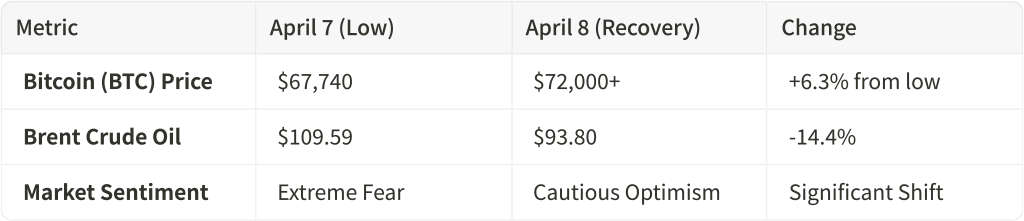
The divergence between Bitcoin and Oil in the wake of the ceasefire is particularly telling. Oil’s value was tied to a physical supply disruption that was resolved. Bitcoin’s value, however, is increasingly tied to its role as a decentralized, non-sovereign store of value that thrives in environments of macro uncertainty. When the "doom and gloom" subsided, investors didn't flee Bitcoin; they recognized it as a primary beneficiary of a stabilizing global liquidity environment.
The "recovery" of Bitcoin was not just about the price returning to $72,000. It was about the volume and the velocity of that recovery. The depth of the buy orders at the $67,000-$68,000 range suggests a massive amount of "sideline capital" waiting for any dip to enter the market. This is the hallmark of a healthy bull market: when a 6% dip is bought up within hours, it signals a market not ready to top out.
One of the key drivers of Bitcoin's recovery was the presence of institutional liquidity. In previous cycles, a 6% dip on major geopolitical news might have triggered a cascade of liquidations, sending the price down 20% or more. In April 2026, however, the market structure is fundamentally different.
The approval and widespread adoption of Bitcoin ETFs, combined with the emergence of specialized funds like Geco Capital's Digital Asset Liquidity Crypto Fund (DLCF), has created a "floor" of sophisticated capital. These investors don't panic-sell on a social media post; they use the volatility to rebalance and accumulate. The quick rebound to $72,000 was a clear signal that the "smart money" saw the "doom and gloom" dip as a temporary dislocation rather than a fundamental change in Bitcoin's value proposition.
We are also seeing a shift in the type of institutional capital entering the market. It is no longer just high-frequency traders and hedge funds. Pension funds, sovereign wealth funds, and traditional asset managers are increasingly adding Bitcoin to their portfolios. For these entities, a dip to $67,000 is an opportunity to lower their average entry price. This "institutional floor" is what makes the current cycle so different from 2017 or 2021.
During the "doom and gloom" window, it's also worth looking at how other "safe haven" assets performed. Gold, for instance, saw a modest uptick on April 7, reclaiming the $4,400 handle. However, its gains were relatively muted compared to the volatility in the oil and crypto markets.
The comparison between Bitcoin and Gold is becoming increasingly relevant. While Gold remains the traditional choice for preserving capital during war, Bitcoin is proving to be the superior choice for navigating the uncertainty of the modern digital age. Its 24/7 market access, instant liquidity, and lack of physical storage requirements make it the "safe haven" of choice for the next generation of global investors.
Furthermore, Bitcoin's correlation with Gold is starting to show signs of "asymmetric upside." While they both act as hedges against fiat debasement and geopolitical risk, Bitcoin has the added benefit of being a high-growth technology asset. When the world is stable, Bitcoin grows because of its network effects. When the world is unstable, Bitcoin grows because of its "digital gold" properties. This dual-purpose nature is something that Gold simply cannot match.
As the two-week ceasefire begins, the focus of the market is shifting from "war risk" to "macro recovery." The significant drop in oil prices is a disinflationary force that could give central banks more room to maneuver. If energy costs remain at these lower levels, we could see a renewed appetite for risk across the board.
For Bitcoin, this is an ideal scenario. It has already proven its resilience during the crisis; now, it stands to benefit from the improved liquidity and sentiment that a de-escalation brings. At Geco Capital, we view this as a "macro catalyst"—a fundamental shift in the environment that justifies a more constructive outlook on digital assets for the remainder of the quarter.
The "macro landscape" is not just about interest rates and inflation. It is about the vibe shift in the market. When people move from a state of "extreme fear" to a state of "cautious optimism," they don't just buy back what they sold. They often look for the assets that showed the most strength during the dip. Bitcoin's performance during the "doom and gloom" window has put it at the top of that list.
The term "resilience" is often overused in finance, but in the context of April 2026, it is the only word that fits. Resilience is not the absence of volatility; it is the ability to withstand it and emerge stronger. Bitcoin's journey from the $67,000 "doom and gloom" low back to $72,000 is the very definition of resilience.
For investors, the lesson is clear: the macro landscape is more complex and interconnected than ever. A single post from a world leader can move billions of dollars in seconds. In such a world, the traditional rules of diversification are being rewritten. Digital assets are no longer a "speculative side-bet"; they are a core component of a resilient strategy.
The "new macro landscape" is one where information moves at the speed of light and assets are traded 24/7. In this environment, the assets that thrive are those that are most liquid and most transparent. Bitcoin, with its public ledger and global exchange network, is the ultimate asset for this new era. It is the only asset that provides a real-time pulse on global sentiment and liquidity.
The modern investor is increasingly comfortable with "digital gold." The generational shift in wealth and the growing distrust of centralized financial systems have created a permanent bid for decentralized assets. When Trump spoke of "doom and gloom," he was speaking to an old world of physical borders and sovereign control. The Bitcoin market, however, represents a new world of borderless value and decentralized consensus.
This psychological shift is what allowed BTC to recover so quickly. While the "doom and gloom" was real for those tied to the physical oil supply or traditional equity markets, for the Bitcoin community, it was just another day of macro noise. This emotional detachment from geopolitical drama is one of Bitcoin's greatest strengths.
The "modern investor" is also more educated. They understand the difference between a "headline risk" and a "fundamental risk." Trump's post was a headline risk. The Iran nuclear threat is a headline risk. But the fundamental risk—the debasement of the dollar and the instability of the global financial system—is exactly why Bitcoin was created. The modern investor sees through the "doom and gloom" and focuses on the long-term structural trends.
The two-week ceasefire is a welcome relief, but it is not a permanent solution. The markets will remain sensitive to any news coming out of the negotiations. However, the precedent set during the first week of April is a powerful one. We now know how the market reacts to "doom and gloom" rhetoric, and we know how it reacts to a breakthrough.
For Bitcoin, the path forward looks increasingly bullish. Having survived the "perfect storm" of geopolitical risk and rhetorical volatility, it has cleared a major hurdle. The $72,000 level is no longer just a resistance point; it is a platform for the next leg of the bull run.
We are also watching the "secondary effects" of the oil price drop. Lower energy costs mean more disposable income for consumers and lower costs for businesses. This is a net positive for the economy and for risk assets. If the ceasefire holds and we move toward a more permanent solution, the "peace dividend" could propel Bitcoin to new all-time highs.
The "doom and gloom" of April 2026 has passed, replaced by a tentative peace and a significantly altered economic landscape. Oil prices have returned to more sustainable levels, easing the immediate threat of an energy-led global recession. But the real story of the week is the survival and recovery of Bitcoin.
Bitcoin’s journey from $67,000 back to $72,000 in the face of a potential global conflict is a powerful signal. It tells us that the "digital gold" narrative is no longer just a theory; it is being practiced in real-time by the world’s largest investors. As we look forward to the remainder of 2026, the lessons of this week are clear: geopolitical shocks will come and go, and rhetoric will continue to move markets in the short term. However, the underlying trend toward digital asset adoption remains unshaken.
Bitcoin survived. Bitcoin recovered. And in doing so, it has once again proven that it is the most resilient asset of the modern age. At Geco Capital, we remain committed to navigating these macro catalysts, ensuring that our investors are positioned to benefit from the resilience and opportunity that only the digital asset market can provide.
The storm may have been intense, but the foundation of the digital asset market is stronger than ever. The "doom and gloom" was just another chapter in the story of Bitcoin's rise. And as we turn the page, the future looks brighter than ever.


