Logout
Login



Bitcoin has spent much of 2026 reminding investors that crypto markets do not move in straight lines. After weeks of consolidation near the low-$60,000s, the market suddenly found its momentum again. In the space of a week, Bitcoin climbed toward the $78,000– $80,000 area, while the broader crypto market capitalisation increased by more than 20%, according to institutional market-data commentary published in August.
The move is encouraging, but its importance is not limited to the size of the percentage gain. The rebound has begun to look broader than a single-asset bounce. Bitcoin led the move, Ethereum and other liquid majors participated, trading activity accelerated, and capital began to return to a market that had spent months competing for attention with equities, artificial intelligence and other macro themes.
That is the difference between a market merely bouncing and a market beginning to reestablish an investable trend. It is also the backdrop against which the recent increase in the unit value of the Geco Capital Large Cap Fund can be understood.
The immediate catalyst was familiar: a market that had become too compressed and too heavily positioned in one direction. Bitcoin open interest had reached its highest level of the year before the move, while realised volatility had fallen to unusually low levels. When a catalyst arrived, short positions were forced to close, amplifying the initial price reaction. More than $1.6 billion in crypto positions were liquidated over a 24-hour period.
A short squeeze can produce an impressive chart without creating durable demand. Forced buying is temporary. It closes leveraged positions, resets market positioning and can quickly fade if spot buyers do not follow. The more constructive feature of the latest move is that the rally was accompanied by evidence of renewed demand in the underlying market.
Weekly Bitcoin ETF inflows were reported at approximately $1.67 billion, while around $3.07 billion of Bitcoin left exchanges. Taken together, those figures suggest that institutional channels were absorbing supply while the amount of immediately tradable Bitcoin was declining. Neither measure guarantees higher prices, but both are more supportive than a rally driven exclusively by derivatives leverage.
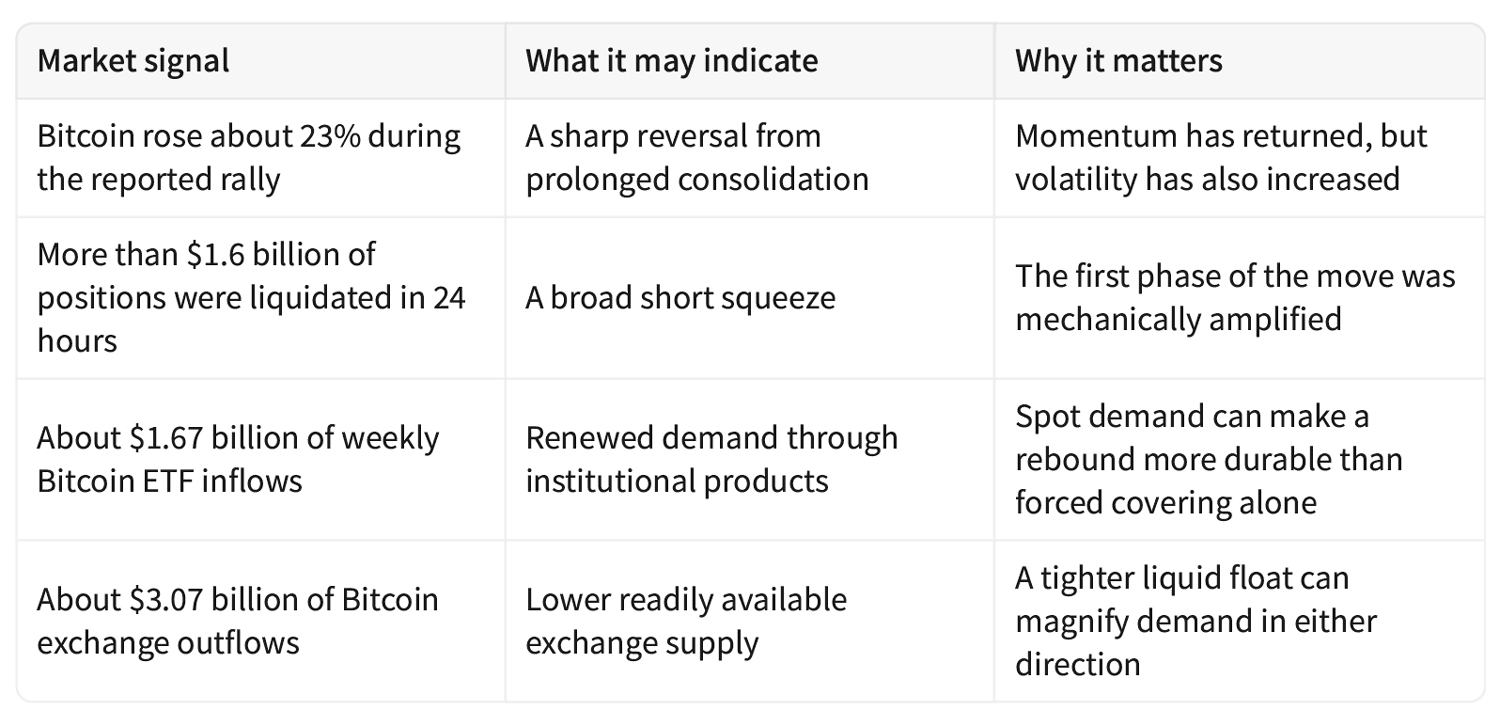
These figures describe the market conditions surrounding the rebound; they are not a forecast.
The latest price action also reflects a change in how Bitcoin is being traded. Earlier in the year, crypto often behaved like a high-beta extension of the technology trade. During the August rebound, however, Bitcoin’s relationship with gold strengthened while its correlation with the Nasdaq 100 weakened.
That shift changes the narrative surrounding demand. If Bitcoin is purchased only as a leveraged expression of enthusiasm for technology stocks, it may be vulnerable when equity multiples contract. If it is increasingly treated as a scarce, liquid and globally accessible asset, it can attract capital from a different pool of investors—particularly when concerns about debt, currency purchasing power or the supply of government bonds become more prominent.
This does not mean Bitcoin has become a conventional safe haven. It has not. Crypto remains volatile, and the same asset can trade as a technology proxy one week and as a monetary hedge the next. The more accurate conclusion is that Bitcoin’s investor base and market function are broadening. That is positive for the long-term development of the asset class, even if it does not eliminate cyclical drawdowns.
The market has moved from pessimism to renewed interest. ETF inflows, exchange outflows, higher volumes and broader participation are constructive signals. They suggest that the rally has attracted more than short-covering and that at least some investors are willing to add spot exposure at higher prices.
Still, the next stage will be more informative than the first. A market can rise rapidly because positioning is crowded, only to give back part of the move when leverage rebuilds. Rising open interest after a squeeze can signal renewed conviction, but it can also recreate the fragility that made the original move so violent. The question is therefore not whether crypto can rally—it clearly can—but whether demand remains present after the forced buyers and sellers have disappeared.
For large-cap digital assets, the most constructive scenario would be a period in which Bitcoin holds its breakout, Ethereum and other liquid majors continue to participate, ETF flows remain positive, and leverage grows more slowly than spot demand. That combination would indicate a healthier market structure than a price spike built mainly on futures positioning.
The move is encouraging, but discipline remains essential. In crypto, a strong week can improve the long-term picture while simultaneously increasing short-term risk.
The market has not become predictable. The balance of forces has simply improved. Capital is returning, participation is broadening and large-cap digital assets are once again attracting attention as a distinct macro asset class. Whether this becomes the beginning of a sustained recovery or another powerful leg within a volatile cycle will depend on the quality of demand that follows.


