Logout
Login



The past three months have been among the most volatile of this cycle — and among the fastest to reverse.
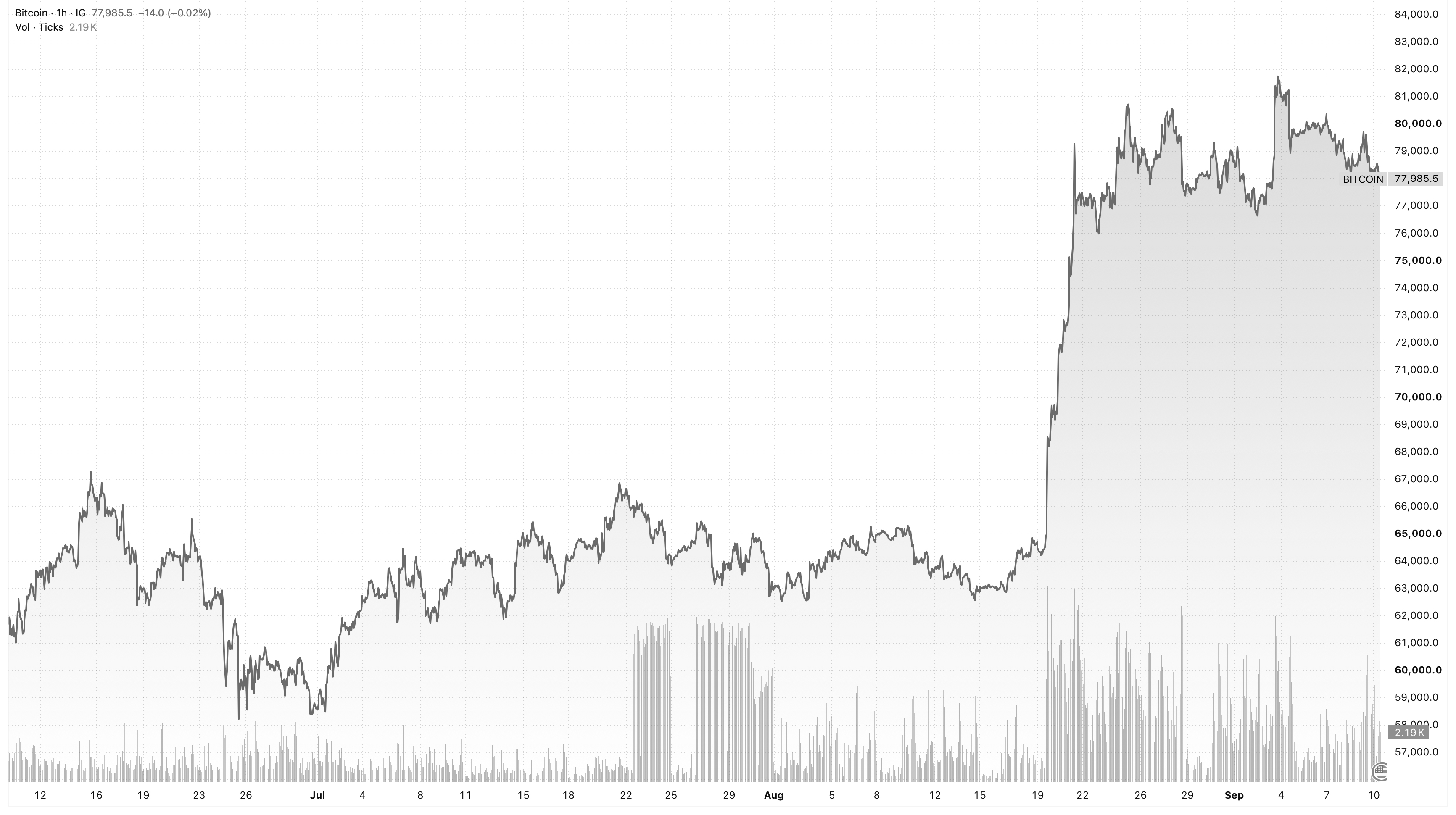
After topping out just above $128,000 in October 2025, Bitcoin ground steadily lower through the first half of 2026. A hawkish Federal Reserve, an escalation in the U.S.–Iran conflict, and a wave of institutional deleveraging combined to push prices down more than 50% from the all-time high. The decline culminated on July 1 with an intraday low near $57,748 — Bitcoin's weakest level since October 2024, and a point at which on-chain profit-and-loss metrics touched levels last seen during the FTX collapse.
What followed was one of the sharper reversals of the cycle. Bitcoin climbed roughly 40% off that July low, reclaiming $69,000 in mid-August as spot ETF buying returned, before pushing above $81,000 in the first week of September — its highest level since May. Unlike some prior drawdowns, this period was not associated with a single major crypto-native failure: no major exchange collapsed, no major dollar-backed stablecoin experienced a sustained loss of its peg, and no reported change occurred to the U.S. Strategic Bitcoin Reserve. Both the pressure and the recovery were driven almost entirely by forces outside crypto itself — chiefly the Federal Reserve and the ebb and flow of spot ETF demand, discussed over the next few pages.
$57,748
Cycle low, July 1, 2026 — down more than 50% from October's all-time high
+40%
Bitcoin's rebound from the July low to above $81,000 by September 4
~$2.7T
Total crypto market cap today, vs. a ~$2.18T trough in early June
Total cryptocurrency market capitalization followed a similar arc — falling from an October 2025 peak near $4.3 trillion to roughly $2.18 trillion by early June, before recovering to approximately $2.7 trillion by September 9, still around 35–37% below the all-time high.
For most of the past two crypto cycles, the market's central macro question has been when the Federal Reserve would start cutting rates. This quarter, for the first time in years, the more live question has been whether it might hike instead. The FOMC, under new Chair Kevin Warsh, has held its benchmark rate at 3.50%–3.75% since December 2025 — five consecutive meetings, including a 9–3 vote at the July 29 meeting in which three members dissented in favor of raising rates. Headline inflation cooled to 3.5% in June from a May spike of 4.2%, but core inflation has stayed stuck around 2.6%, well above the Fed's 2% target.
The tone shifted decisively on August 28, when Warsh used his debut Jackson Hole address to call inflation “concerning” and pledge that the Fed would “ensure inflation returns decisively to target.” Futures markets moved fast: the implied odds of a 25-basis-point hike at the September 15–16 meeting jumped from roughly 34% to as high as 66% within days. The reaction across markets was immediate — Bitcoin fell from above $81,000 to near $77,000 within hours, part of a synchronized, roughly $2 trillion selloff spanning stocks, metals and crypto.
What stands out is that this more hawkish repricing has not derailed crypto's recovery. A U.S. Treasury decision to expand purchases of longer-dated government debt was reported to ease pressure on long-term yields even as the Fed talked tough, and institutional ETF buying continued straight through the volatility (see next page). As one digital-asset strategist put it following the Jackson Hole reaction, Bitcoin has been responding less to the specific rate decision itself and more to the broader liquidity backdrop — “the same channel that drives gold.”
“Bitcoin doesn't respond to the September decision. It responds to global liquidity and to where the long end of the curve settles — the same channel that drives gold.”
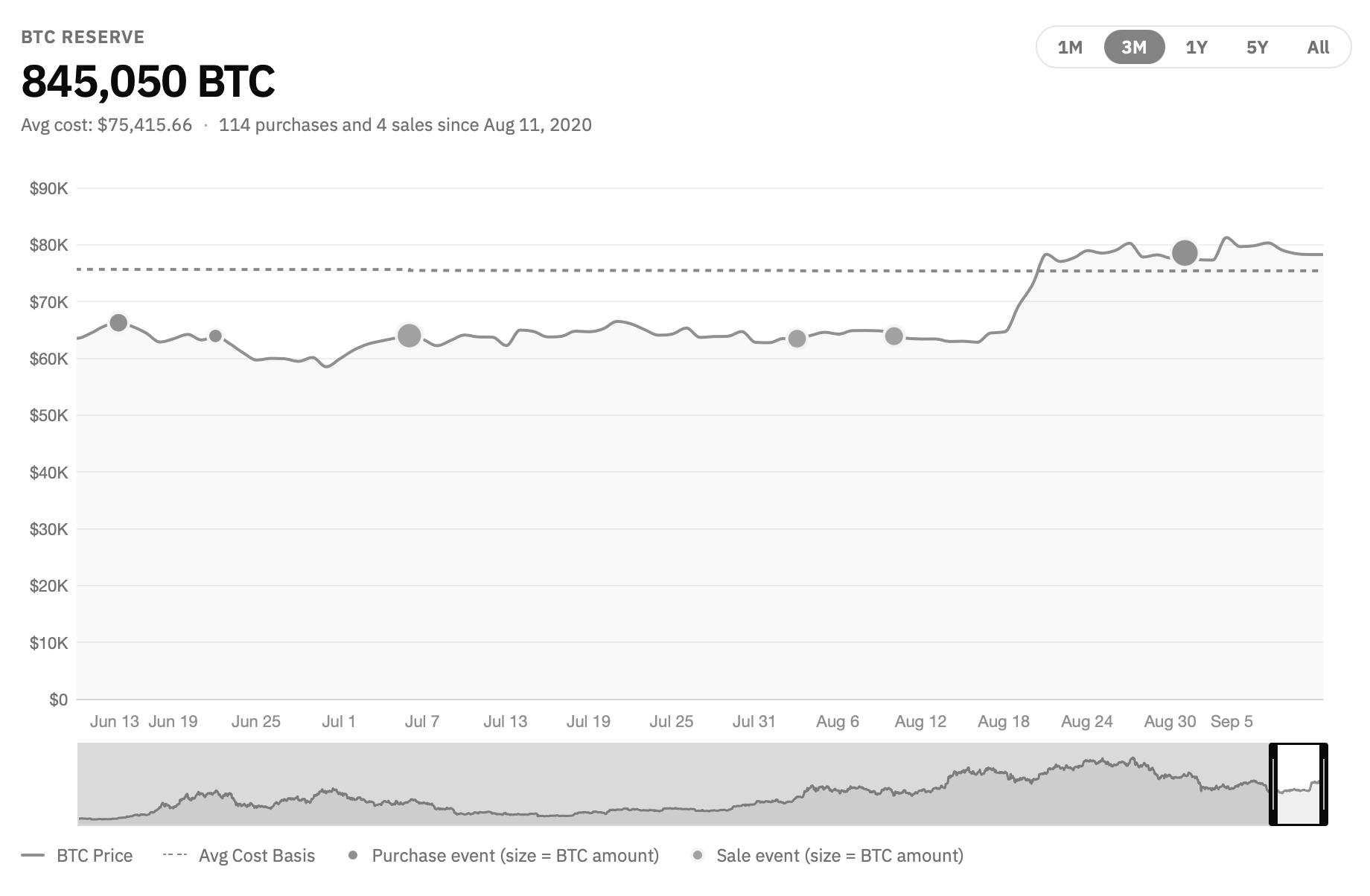
Strategy Inc. (formerly MicroStrategy), the world's largest corporate holder of Bitcoin, delivered one of the quarter's more surprising headlines: its first-ever sale of Bitcoin. After growing its holdings to approximately 846,000 BTC during the second quarter, the company conducted several Bitcoin sales during the summer, reducing its holdings to 840,447 BTC by early August. The move, which surfaced alongside a broader market selloff, rattled sentiment around MSTR shares, already trading more than 60% below their 2025 peak.
The pause did not last. On August 30, Strategy confirmed a fresh purchase of 4,603 BTC, funded through equity issuance, taking holdings back up to 845,050 BTC — approximately 4.00% of Bitcoin's entire 21 million supply, still comfortably the largest corporate or institutional holder outside of the spot ETFs. As of the September 8 filing, holdings remained unchanged at 845,050 BTC, acquired at a total cost of roughly $63.73 billion, for an average price near $75,412 per coin. Rather than resume buying that week, the company instead repurchased $176.3 million of its STRC preferred stock and doubled its buyback authorization for its digital-credit securities program to $2 billion — a reminder that balance-sheet management has become as central to the Strategy story as Bitcoin accumulation itself.
845,050 BTC
Strategy's holdings as of Sept 8, 2026 — ~4.00% of total BTC supply
$75,412
Average cost basis per BTC, total cost basis ~$63.73 billion
$20.9B
Common and preferred stock raised year to date — fourth-largest U.S. equity issuer by capital raised in 2026 to date.
U.S. spot Bitcoin ETFs recorded their first negative six-month net-flow period since launching in early 2024, shedding a net $5.4 billion between January and June as the broader sell-off accelerated. Outflows were heaviest in late June, coinciding with Bitcoin's slide toward its cycle low, and July brought only a partial reprieve: a seven-session streak collected close to $1 billion before snapping on July 24 with a $225 million single-day outflow.
August told a different story. The week of August 3–7 brought $853.5 million in net inflows — the category's best week since April — with BlackRock's IBIT alone responsible for 81% of the total. Momentum built from there: a $517 million single-day haul on August 19 coincided with Bitcoin's break back above $69,000, and by the run-up to Jackson Hole, spot Bitcoin ETFs had strung together eight to nine consecutive sessions of inflows totaling roughly $2.8 billion, pushing the month's total past $3 billion — the strongest month of 2026 for the category. Cumulative net inflows since the 2024 launch now stand at roughly $52–53 billion, with total assets near $80–84 billion, equal to about 6.1% of Bitcoin's total market capitalization.
Ethereum ETFs told an even stronger story heading into September, pulling in $986.9 million in a single week — the category's best week of the year — as part of a three-week run that brought in $3.8 billion combined, at times outpacing Bitcoin ETF flows on a relative basis and signalling a rotation of institutional attention toward ETH.
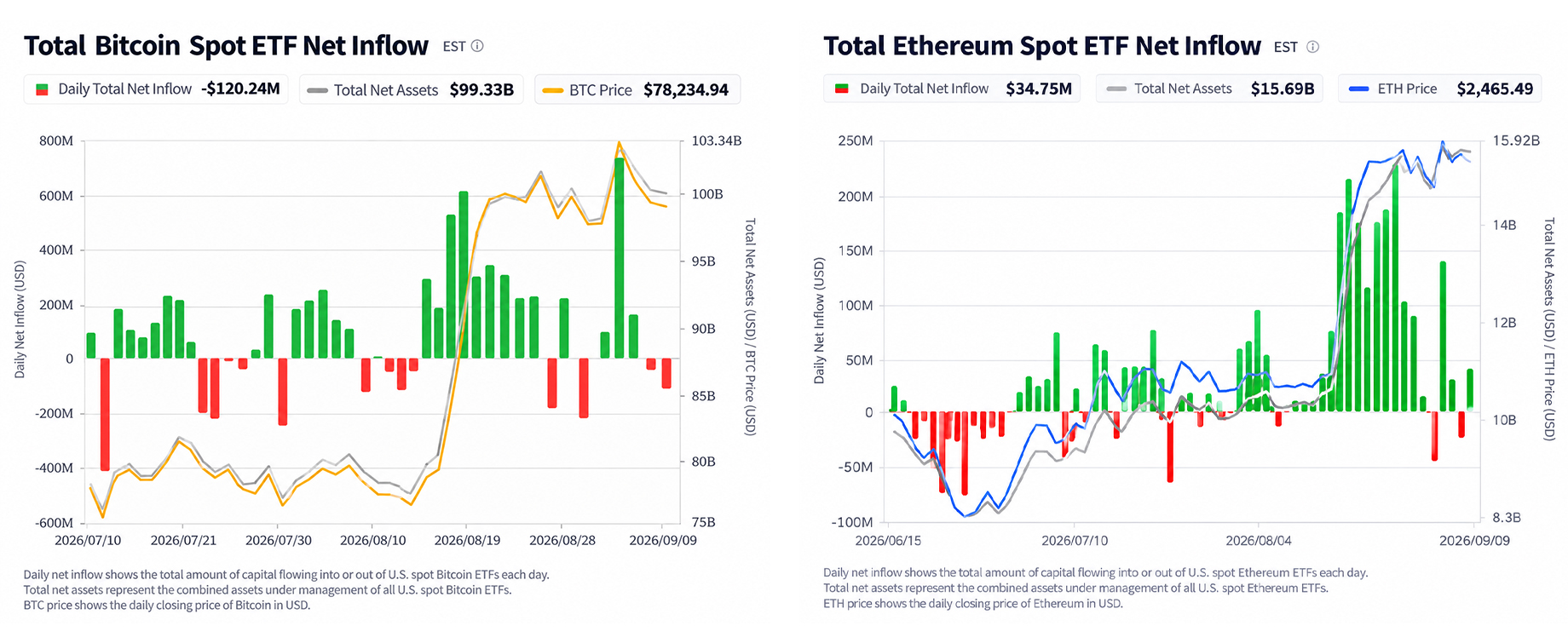
Ethereum's round trip this quarter was even sharper than Bitcoin's. ETH fell to roughly $1,550 around the same early-July low, before staging a stronger relative recovery — climbing above $2,500 by early September, an advance of more than 60% from the bottom. According to BitMine Chairman Tom Lee, Ethereum has been the best-performing major macro asset of the third quarter to date, outperforming the S&P 500 by more than 5,400 basis points through the first week of September.
Corporate treasury demand has been a visible part of the story. BitMine Immersion Technologies, which pivoted to an Ethereum-focused treasury strategy in mid-2025 and has purchased ETH every week since, grew its holdings from 5.81 million ETH on August 9 to 5.93 million ETH by September 7 — worth roughly $14.8 billion and equal to about 4.9% of Ethereum's total supply. Including cash and smaller minority stakes, BitMine's total holdings reached $15.7 billion, making it the second-largest publicly disclosed corporate digital-asset treasury behind Strategy. Approximately 5.067 million ETH, or about 85% of BitMine’s holdings, was staked through MAVAN and its staking partners. BitMine reported approximately $330 million in current annualized staking revenue, with projected revenue of approximately $386 million at full staking scale.
Ethereum's network roadmap also advanced this quarter: the Ethereum Foundation launched a public testnet for the long-delayed “Glamsterdam” upgrade in mid-August, though mainnet activation has slipped again and is now targeted for the fourth quarter of 2026.
~$1,550
Ethereum's cycle low, around July 1, 2026
5.93M ETH
BitMine's Ethereum treasury as of Sept 7 — ~4.9% of total ETH supply
+60%+
ETH's advance from its July low to early-September highs

The crypto industry's central legislative priority for 2026, the Digital Asset Market Clarity Act, enters the final stretch of the year hanging by a thread. Having passed the House and cleared the Senate Banking Committee by a 15–9 vote in May, the bill missed its chance for a floor vote before the Senate's August recess. Senate Majority Leader John Thune has scheduled a procedural cloture vote for September 15 — requiring 60 votes to advance — with lawmakers returning from recess with only about 14 working days before an October election recess. Sticking points include whether state attorneys general or the Department of Justice should enforce the bill's ban on government officials operating crypto businesses, and banking-industry objections to provisions that would let exchanges offer yield on stablecoin balances. Even some of the bill's own champions have grown pessimistic about its odds of passage before the 2026 midterms.
On the stablecoin side, the regulatory picture is further along. The GENIUS Act, signed into law in July 2025, established a federal framework for payment stablecoins, including reserve requirements, disclosure obligations, and restrictions on issuers offering interest or yield directly to holders. The framework is generally expected to take effect by January 18, 2027, subject to the statutory implementation timetable. The global stablecoin market has grown steadily through the turmoil, standing at roughly $308 billion in mid-August — up 14.3% year-over-year even after a slight pullback from a May peak near $322 billion. Tether's USDT retains roughly 59% of the market, with Circle's USDC around 27%; in Europe, MiCA has supported Circle’s regulated presence, while some EU-regulated venues have restricted or delisted certain Tether products because of compliance requirements, a dynamic Geco Capital continues to monitor closely given its Estonian, EU-regulated base.
Sept 15
Senate cloture vote on the Clarity Act — needs 60 votes to advance
~$308B
Global stablecoin market cap, mid-August 2026 (+14.3% YoY)
Jan 2027
GENIUS Act framework expected to take effect for covered U.S. payment stablecoin issuers.
The past three months have been a study in how mature crypto market structure has become. A drawdown that took Bitcoin down more than 50% from its all-time high, and a recovery that brought it back above $81,000, both played out without a single crypto-native crisis — no failed exchange, no broken stablecoin peg. Instead, the story was told almost entirely through macro liquidity, spot ETF flows, and the balance-sheet decisions of a handful of large institutional holders, from Strategy's first-ever Bitcoin sale to BitMine's steady weekly accumulation of ETH.
Two binary catalysts now sit directly ahead: the Senate's procedural vote on the Clarity Act on September 15, and the Federal Reserve's rate decision on September 16. Markets head into both with total crypto market capitalization back near $2.7 trillion — up roughly 24% from June's trough, but still around 35–37% below October's record high. Whichever way these two events break, the underlying trend of the past quarter — deepening institutional infrastructure absorbing shocks that in prior cycles might have caused far more lasting damage — looks set to continue defining the market into year-end.
Unlike several recent Bitcoin drawdowns, this decline has so far lacked a single dominant crypto-native failure. No major exchange collapsed, no major dollar-backed stablecoin experienced a sustained loss of its peg, and the decline appears to have been driven primarily by macroeconomic forces.
This report is an interim market update covering publicly available market data from July 1 through September 9, 2026, and covers publicly available market data through September 8–9, 2026. It does not include GCLCF fund performance figures, which are published separately to fund shareholders. Prices and flow figures compiled from public reporting (CoinDesk, SoSoValue, The Block, Yahoo Finance, Fortune, Cryptonomist, SEC filings and company disclosures) are approximate and intended for illustrative purposes; see individual chart sources for detail. This document is market commentary, not investment advice.


